Lao wushu fighters smashed their medal target yesterday, winning three more gold medals to add to their tally in the sanshou finals on the last day of wushu events at Lao-ITECC.
The first gold came from Khamla Soukaphone, who beat Phan Vah Hau of Vietnam in the 52kg category. Phoxay Aphailath won the day?s second gold for Laos in the 56kg category, defeating the Philippines? Benjie Rivera, while a third came from Bouapha Valasith, who beat Junaidi Sukamto Rahmat from Indonesia in the 60kg category. The President of the Lao Wushu Federation Mr Oudomsak Oudomthongkasem expressed his satisfaction that the Lao fighters had morethan doubled the federation?s medal target at the SEA Games, winning five gold, two silver and 4 bronze medals.
?Wushu is still a new sport in Laos, after this achievement our federation will expand in Vientiane and other provinces to draw on more resources and train good fighters to compete in the next SEA Games and do even better than in this event,? he said.
The Lao Wushu Federation entered 10 men and nine women in the 25th SEA Games wushu events, competing in men?s and women?s changquans (long fist, broad sword play and cud get), nanquans (southern fist and southern cudgel play), taijiquans (taijiquan and taijijian), duilian (barehand and weapon) and sanshou in weight categories of 45 to 65kg.
Their current successes build on those of previous SEA Games competitions, where in recent years Lao fighters have come away from the events with gold, silver and bronze medals.
Hundreds of fans packed the Budo Centre yesterday to cheer on 22-year-old Lao fighter Ms Phonenaly Sayarath who rewarded them with Laos ' first gold medal in judo.
As her supporters' shouts rose to a crescendo, Ms Phonenaly defeated her Thai opponent Sureerat Sadmaroeng in the final round of the women's under 52kg weight division.
Three Lao fighters competed in yesterday's final rounds at the Budo Centre.
The fans' enthusiasm was rewarded by Ms Phonenaly's gold medal and the efforts of two other Lao fighters, Ms Syamphone Phetnida in the women's under 48kg and Ms Chitchinda Bounphaaksone in the under 75kg, who both won silver medals.
Ms Syamphone and Ms Chitchinda were outmanoeuvred in their final rounds by their Vietnamese rivals Van Ngoc Tu and Nguyen Thi Kieu.
Ms Phonenaly's gold medal was her first and also the first for the Lao Judo Federation at this SEA Games c ompetition.
“I am really happy to have won gold at the SEA Games, especially since the event is taking place in my motherland. Thanks to all of my fans for cheering for me,” she said.
Ms Phonenaly has competed in the SEA Games on three occasions. The first was at the 23rd SEA Games in 2005 in the Philippines , and her second medal attempt was at the last SEA Games in Thailand in 2007.
“I finally have the top prize after winning bronze at the last SEA Games and getting nothing in the Philippines ,” she said.
She believes her success at this year's games is the result of two years of hard training in Japan , where she is studying.
Judo fighters competed for seven gold medals yesterday. Vietnam won three gold medals, while Myanmar , the Philippines and Thailand received one each.
Today, seven more gold medals are up for grabs in judo.
Laos has high hopes for two in the men's over 100kg and under 90kg categories, according to Lao judo trainer Chittiveth Nouankhaising.
The Media Communication Committee made a significant achievement in contributing to the success of the 25th SEA Games, Deputy Minister of Information and Culture Prof. Dr Bosengkham Vongdara said yesterday at a press conference at the Media Centre.
Dr Bosengkham, who is also Media Communication Committee Chairman for the 25th SEA Games, said “Information from reporters and the media contributed greatly to the success of the SEA Games. We made an admirable and significant contribution to the promotion of the event. Lao people living in the provinces and overseas and all those interested in the games received timely information. We saw people living in Vientiane respond and actively take part by attending events and showing their enthusiasm.” Dr Bosengkham said reporters and media organisations had benefited and raised their skill level through their coverage of the games. Reporters now knew how to better cover, send news and coordinate among themselves and other countries. The government has invested a large amount of money in the media to improve infrastructure, training and equipment.
“Feedback from the public suggests they think the media have done a good job, with presenters and reporters in the field giving good information,” Dr Bosengkham said.
The Media Communication Committee consists of five sub-committees, which all started preparing for the SEA Games in August 2008. They have promoted the event from December 2008 right up to the opening day of the SEA Games on December 9.
The committee and media organisations across the country created several special programmes for radio and television and published newspaper articles to deliver information to the public in a timely manner.
“All media organisations performed well in the important tasks the government assigned them,” Dr Bosengkham said.
More than 700 local journalists participated in covering various areas of news relating to the SEA Games.
“Reporters have been actively reporting news since before the start of the games until the opening ceremony,” Dr Bosengkham said.
Apart from this, 1,600 foreign journalists from Asean countries took part in the SEA Games, writing many articles about the event. People in Asean countries received information about the opening ceremony and every sporting event from journalists doing an important job in Laos .
The foreign news agencies took SEA Games news and produced TV programmes. They also booked a live broadcasting room. This allowed people living in Europe and the United States to watch the games.
Dr Bosengkham said Lao Channel 1, 3 and Lao Star broadcast their programmes to the world and in the Lao provinces. Local people and Lao people living overseas all enjoyed watching the games on these channels.
Despite gaining seven more gold medals yesterday, Laos remains at seventh place in the medal standings while Vietnam and Thailand are in a head to head battle for top honours.
The battle for medals will end this morning, with the afternoon set aside for preparations for the 25th SEA Games closing ceremony at the National Stadium.
The ceremony will begin at 5:10pm with musical entertainment, followed by a programme of performances and displays.
The first gold medals for Laos yesterday came in the morning thanks to experienced boxers in the muay Lao (kick boxing) ring with their haul of three gold medals in wushu sanshou at Lao-ITECC.
Some of the tactics used in muay Lao are very similar to those employed in wushu sanshou, which gave Laos the edge and brought them resounding success on home soil.
To date, the wushu team has taken five gold, two silver and four bronze medals. After the five muay Lao gold medals they earned earlier in the week, the team has become the most successful in Laos at the games.
The first gold of the day for Laos was a victory by Khamla Souphaphone after he easily beat Phan Van Hau of Vietnam in the men's 52kg boxing event. Khamla won the silver medal at the last SEA Games in 2007 in Thailand .
Khamla was the best boxer in the muay Lao ring with 70 fights to his credit. Muay Lao fans know him as Anantaxay Sor-souphaphone.
“This gold medal is a good token for me to welcome in the New Year of 2010 and also a wonderful reward after a long year of hard training,” Khamla said.
“I have to thank all of my supporters around the country, especially the people of my hometown of Nahai village in Hadxaifong district, Vientiane , for cheering me on to victory today.”
More gold medals in wushu followed from 2006 Asian Games silver medallist Phoxay Aphailath in the men's 56kg and Bouapha Valasith in the men's 60kg category.
Other gold medals taken by Lao athletes yesterday included one in the men's under 120kg judo event for Khemkham Kommanivong, one in the boxing ring for Vilasak Khouandy in the men's 64kg light welterweight, one in men's surface fin swimming 200m for Bounthanom Vongphachanh, and another in the men's pencak silat class I under 90kg for Pheumthavy Vongphackdy.
Yesterday was a day of victory for Lao athletes at the ongoing SEA Games on home soil when they reached their target of 25 gold medals, as some optimists had predicted ahead of the games.
The eighth day of competition will go down in the record books as being the day when the magic number of 25 gold medals for Laos was reached in 25 sports at the 25th SEA Games.
The first gold medal yesterday came at 5:31pm, after a long day of waiting, thanks to Phonenaly Sayarath who won the women's under 52kg division in judo.
Other gold medals that pushed Laos towards success came from the swimming pool at 6pm, when Chrichina Sindara won the women's 50m surface fin swimming event and Amdavanh Phanmibounkong won the women's 400m surface fin swimming event.
Despite having reached their gold medal target, Lao athletes will continue to pursue their quest for even more gold in the last two days of competition.
The petanque team, who were favourites to win a gold medal yesterday, managed only bronze.
Of the 11 gold medals up for grabs in petanque Laos is hoping to claim at least four. So far, they have picked up one gold, one silver and five bronze medals in the sport.
The gold medal was won in the women's doubles on Monday by Manivanh Souliya and Noitavane Pasert.
The final two gold medals in petanque will be there for the taking on Friday in the men's and women's triples events.
Yesterday afternoon Laos claimed a silver medal when 20-year-old Milvady Hongfa took second place in the women's light flyweight 48kg boxing event.
On the shuttlecock court where Laos hoped to win one gold medal from the two events being contested, the team scooped two silver medals, with both golds going to the more experienced Vietnamese team.
In the round robin competition in women's football, Laos came in fourth, while Myanmar took the bronze medal. The gold medal was won by Vietnam after they beat defending champion Thailand 3-0 in a penalty shootout at Chao Anouvong Stadium yesterday.
The last men's football matches will take place today. The bronze medal match between Laos and Singapore kicks off at 3pm at Chao Anouvong Stadium, while the gold medal match between Vietnam and Malaysia will begin at 5pm at the National Stadium.
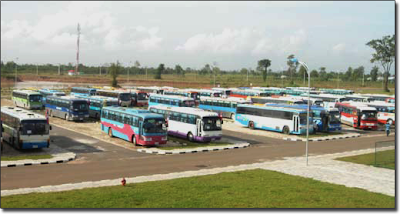
Spectators returning home after the SEA Games are assured there will be plenty of buses running to the north and south, when the games end on December 18.
Bus operators told Vientiane Times yesterday they had enough buses to provide everyone with a journey home, whether going north or south, and there was no need to worry about getting a seat.
An official in charge of bus provision at the Chitprasong Transportation Company (northern route), Mr Khamdy Phimmasone, said there would be about 100 buses available, including privately owned buses registered with the company.
“I believe this number will be sufficient to transport everyone in the rush to return home after the games,” Mr Khamdy told Vientiane Times.
The company has been able to provide extra buses at peak times in the past, especially at the busiest time of the year during Pi Mai Lao (Lao New Year) in the middle of April when many people travel, he said.
At that time there are more than 50 buses in service - double the number that normally run on regular routes.
Mr Khamdy was unable to say how many extra buses would be added to cope with SEA Games passengers, saying it depended on demand.
“We will organise extra buses depending on the number of passengers. We can have buses available if need be and can organise additional buses immediately if they are required,” he said.
The situation is similar going south, with the Chitprasong Transportation Company ready to get travellers home, according to Southern Terminal Transport Association President, Mr Khamsaen Thammavong.
Bus companies are expecting a surge in customers after the games. As well as a boost in Lao passengers they anticipate a rise in foreign visitors travelling onwards to other parts of the country.
Transport providers had their busiest time at the start of the games when supporters from the provinces flocked to Vientiane .
Extra buses were laid on between the provinces and the capital and they were always full, bus operators said.
Normal services are running at present with one bus departing for the southern provinces every 30 minutes from 4:30am to 8:30pm every day and one bus every one to two hours going north from 6:30am to 8pm.
The situation is fairly quiet at the moment.
“Fewer people are travelling these days because so many people are in Vientiane for the games. However, we expect a rush when the games are over,” Mr Khamsaen said.
He said more people were booking bus tickets these days, perhaps because they were afraid there would be a shortage of buses.
“No problem, we have enough buses available,” he said.
The Lao muay team became the most successful in the country's history when the close of competition at the ongoing SEA Games saw a haul of five gold medals around their necks.
Yesterday was the final day of the muay events at this year's SEA Games. The Lao team had four boxers in the ring competing in seven gold medal bouts. At the end of the day the Lao team took home three gold medals and one silver.
The team won two other gold medals, two silver medals and one bronze medal on Monday.
The three gold medals for Laos yesterday came from Phoutthasone Keosayavong in the female light flyweight 48kg, Thongbang Seuaphom in the male flyweight 51kg and Paylor Xaypao in the female featherweight 57kg division.
Thongbang Seuaphom said after the medal presentation ceremony “This gold medal is a great honour for me because it is my international competition debut.”
“My future now is to continue to have more international fights with the national squad and to win more gold medals for Laos ,” the 20-year-old Thongbang said.
On the same day, the shuttlecock team also had their best success by scooping two gold medals and one silver.
The first gold came in the men's doubles from Southisone Thonmanivong and Khamphong Phouthong.
Another gold medal was won in the mixed doubles by Ms Pathoumphone Phammachane and Mr Phongeun Kongmany, while the silver medal was won in the women's doubles by Ms Malaythong Daosisavan and Ms Khamkhoun Luanglath.
Yesterday's gold medals followed the first gold medal for the shuttlecock team on December 13 from Southisone Thonmanivong in the men's singles event.
Vice Minister and Head of the Prime Minister's Office and President of the Lao National Shuttlecock Federation, Prof. Dr Boviengkham Vongdara, said yesterday “After three days of competition our team has won three gold medals and one silver medal. This is a very great success.”
“Although today is the final day of the shuttlecock competition, there are still two gold medals up for grabs for the men's and women's teams. Our hope is to win at least one more gold medal.”
The latest medal standings updated at 7pm on Tuesday placed Laos in seventh position out of the 11 competing countries with 22 gold, 11 silver and 35 bronze medals. This was on the seventh day of competition since the official opening ceremony on December 9.
The best medal tally for Laos in any previous SEA Games was 5 gold, 7 silver and 32 bronze medals.
Khamla Xayavong, 21, has become the latest Lao hero after scooping three gold medals in shooting events.
Yesterday Khamla struck gold in the 10m running target mixed event.
She won the event with a score of 358, beating silver medallist Ha Dang Hong of Vietnam, who scored 353 points, while Khamla's team-mate Hongkham Xayalath took the bronze medal with a score of 352.
Khamla also bagged a silver medal in the mixed 10m running target category, scoring a total of 1,040 points.
The gold medal in this event went to Vietnam with 1,043 points, while bronze went to Thailand with 977 points.
“I am very happy and proud to win three gold medals and a silver for the home fans. In the future I will try to improve my shooting skills and hope to be a national shooter forever if the nation needs me,” said an excited Khamla.
Before picking up her third gold medal yesterday, Khamla scored 367.0 to set a new SEA Games record in the women's 10m running target event on Saturday. The previous highest score in this event was 358.0. She collected another gold medal on the same day in the women's 10m running target team event.
Now sports fans around the country are in awe of Khamla because it is the first time in Lao sporting history that one competitor has won more than one gold medal at the SEA Games.
Three gold medals is a wonderful present for Khamla as she approaches her 22nd birthday on December 30.
So far, Lao shooters have amassed three gold, one silver and one bronze medal.
SEA Games Organising Committee Chairman Somsavat Lengsavad said yesterday the games will raise Lao sport to a higher level because of the enthusiasm shown by local people in supporting Lao athletes.
“SEA Games fever has shown that people want to cheer for and support their athletes in popular sports so this leads me to believe Lao sport will improve,” he said.
Mr Somsavat said many foreigners had told him they couldn't believe that Lao people could be so interested in the games. “I don't want to congratulate my own country but many national leaders in this region have congratulated us on our good preparations and infrastructure which has contributed to the success of the games so far.”
He said many delegations had also congratulated him on the standard of the various sports venues including those used for shooting and table tennis, saying they were better than those in other countries in the region.
“They also said we should organise other international sports events in the future.”
Mr Somsavat said he was proud of the way local people welcomed various visitors during the games with warm smiles and hospitality. He also congratulated Lao athletes, saying the SEA Games was an important event in the history of Laos .
“Our athletes have done well, winning many gold, silver and bronze medals even though the games are still not over. Laos has never had such medal success. But this time we are the hosts so our athletes trained hard for this victory.”
Mr Somsavat talked about the Lao footballers, saying they had played very well to be in the semi-finals. In the past, Laos had never reached the semi-finals.
“Today, I can say our footballers have greatly improved because of their dedicated training. They are trying to do their best, especially as we are the hosts of this event.”
He urged people to continue to show their support for Lao athletes until the end of the games, saying cheering was the best source of energy and inspiration as they pursued their medal quest.
“All Lao people should show their support right up until the end of the games. And we should continue to give visitors a warm and polite welcome, as well as taking care of the environment so the country looks its best for all delegations, guests and tourists visiting Laos,” he said.
Spectators around the country have been impressed by the high standard of Lao martial arts fighters and proud of the medals they won have at the SEA Games so far.
Martial arts disciplines being contested at this year's games comprise taekwondo, wushu, judo, muay, boxing, karatedo, wrestling, and pencak silat.
Competing athletes reached a high standard of physical fitness ahead of the games, with many training in camps in neighbouring countries. They also reached higher standards in recent international competitions than in the past.
At the Lao-ITECC indoor stadium on Sunday, the Lao wushu team won two gold medals in the men's and women's doubles in duilian (pair) events.
Soudaphone Chanlapheng, 14, and Ketsuda Vongphakdy, 19, were both gold medalists in the women's duilian event, while Anousone Sasabo, 20, and Bountang Song, 18, won gold in the men's duilian event.
This has been the most successful start ever for the Lao wushu team.
Wushu competitions are taking place at the Lao-ITECC indoor stadium from December 13 to 17.
Taekwondo featured earlier in the games from December 10-12, with the Lao team taking three gold medals.
The Lao team has never won any medals at international level in the dancing style but at this year's games they have the home team advantage and are also much better prepared.
At the 24th SEA Games in Thailand in 2007 they won a gold and two bronze medals in the fighting style.
Tao lu events at the 25th SEA Games include changquan (long fist), nanquan (southern fist), taijiquan (shadow boxing), daoshu (broadsword), jiashu (sword), nandao (southern broadsword), jianjijian (taiji sword), qiangshu (spear), gunshu (cudgel), nangun (south-style cudgel), duilian (pair events) with and without weapons and jiti (group or team events).
Lao gold medallist in the men's 54kg flyweight division Phoutthavong Outhasak found it easy to beat his Cambodian opponent Chhoy Bouthorn 13-1 in the final at Booyong Gymnasium last Saturday.
Phoutthavong beat his Thai opponent Pen-ek Karaket 5-4 before going on to beat the Cambodian fighter.
Phoutthavong had earlier won a silver medal in the men's 58kg division in Thailand 's 24th SEA Games.
Still to come are the boxing, wrestling, muay, and judo events, which will be held at the Lao-Japan Budo Centre from December 15-17.
Ten-times overall champions of the SEA Games offer the most money for winning a SEA Games gold with their winning athletes set to receive 200,000 baht (US$6,000) each. According to the National Sports Development Fund's scheme, the silver medallist will take 100,000 baht (US$3,000) and a bronze winner 50,000 baht (US$1,500). But it is not only the athletes who will enjoy the benefits, sports associations will also be rewarded where they will receive 60,000 baht (US$1,800) for each gold medal, 30,000 baht (US$900) for a silver and 15,000 baht (US$450) for a bronze.
The coaches will get 40,000 baht (US$1,200) for a gold, 20,000 (US$600) for a silver and 10,000 baht (US$30) for a bronze. In all, the Fund will have to pay a total of around 300,000 baht (US$9,000) for every gold medal won. 'It is quite a high sum compared to that offered by other countries,'' said Thai official Sakol Wannapong. But it is not easy to lower the bonus because this would face opposition from the sports associations.
For the SEA Games in Laos, the Thais are targetting 100 gold medals from the 377 at stake. In the meantime, Indonesia have allocated a fixed sum for all their successful athletes where should they meet their target of 62 gold medals, each gold medallist will get 50 million rupiah (US$9,000). Singapore will give a bonus to only the gold winners - with a carrot of S$10,000 (US$7,000) with a further US$3,500 for additional gold medals won.
A record-breaking feat will earn Singapore athletes US$3,500. For hosts Laos who target 25 gold medals, the Lao Telecommunications Company (LTC) will provide 30 million kip (US$3,600) for a gold medal, 20 million kip (US$2,400) for a silver medallist and 10 million kip (US$1,200) for a bronze medallist.
On the other hand, Cambodia's gold medal winners have been promised 24 million riel (US$6,000) and the coach will get the same amount. For winning the silver, an athlete will take home 16 million riel (US$3,800) with 8 million riel (US$1,900) for bronze.
Vietnam will pay a gold winner US$1,500 each with Myanmar paying the same US$1,500 while a Philippine champion will get 300,000 peso (about US$4,700) each.
It was double joy for Quah Ting Wen, who not only swept the first gold in swimming for Singapore by winning the women’s 100m freestyle but also had the distinction of setting the first new Sea Games record in the 25th edition of the biennial Games with a time of 56.03s. She rewrote the 10-year-old record of 56.05s set by compatriot Joscelin Yeo in 1999 at the SEA Games in Brunei. Thailand’s J. Natthanan took the silver in 56.33 while another Singaporean Lim Xiang Qi (56.60) settled for the bronze.
“I was rather nervous in the final. There were many other good swimmers. But I was confident of setting a new record if I win the gold,” said Ting Wen.
In the men’s 200m backstroke Singapore struck gold again through Zach Ong with a time of 2:03.27 while the silver was won by Ryan Arabejo of the Philippines (2:04.36) as Rainer Ng also of Singapore won the bronze 2:06.10. Singapore ’s third gold came through Tao Li in the women’s 200m backstroke with a time of 2:17.12 – far below the existing record of 2:16.76 set by Akiko Thomson of the Philippines set in 1993. Thailand’s T. Chavisa settled for the silver with a time of 2:19.87 while Shana Lim of Singapore the bronze in 2:20.98.
Malaysia broke Singapore’s domination in the pool when Siow Yi Ting clocked a fast 2:14.57 on her way to the gold and new Games’ record in the women’s 200m individual medley. The old record stood at 2:17.17 set by Singapore’s Jocelin Yeo in 1999.
Thailand’s J. Natthanan (2:18.98) and Singapore’s Koh Hui Yu settled for the silver and the bronze respectively.
IT was a historic moment for Laos when the 25th South East Asian (SEA) Games was officially opened in a colourful ceremony steeped in cultural and historical significance at the new National Stadium in Vientiane last night.
Despite being a founder member when the Games debuted in 1959, Laos, known as “the ancient kingdom of a million elephants”, are hosting the biennial event for the first time.
The Games are also held in celebration of the 450th anniversary of Vientiane as the capital of Laos in 2010.
Tagged as the ‘Generosity, Amity, and Healthy Lifestyle’ Games, the hosts are keen to stress home the point that solidarity and friendship are more important than winning among the South East Asian neighbours.
About 7,000 students were involved in the cultural performances in the opening ceremony, which included dances titled “Welcome SEA Games, Sound of Jungle, Golden Rice Field, Fairness Candlelight, Sin-Xay the hero of an era, Bright Future and Binding Heart to Step Forward”.
The performances celebrated the abundance of cultural and ethnical diversity in the former French colony.
Among the dignitaries who graced the ceremony was Laos President Choummaly Sayasone and he was joined by the Prime Ministers of Thailand, Cambodia, Myanmar and Vietnam.
Countdown the opening
Part I
Part II
Part III
Torching
Part IV
Part V
Part VI
Part VII
Part VIII
All video clips from langvannavong Source: Thestar, Malaysia
The nation's most anticipated event finally unfolded last night when the biennial regional sports competition, the SEA Games, officially opened in the Land of a Million Elephants.
Some 8,000 performers put on an unprecedented display of pageantry for the 20,000 spectators attending the grand opening ceremony of the 25th SEA Games at the National Stadium in Vientiane on Wednesday evening. This is a truly great opportunity for Laos to show the world, especially the Asean region, that we can host an event in a style that befits the 50th anniversary of the Southeast Asian Games Federation.
Over 20,000 people flocked to the National Stadium last night to share in a joyful occasion that united everyone lucky enough to be present.
Spectators joined with government members and foreign guests in welcoming the athletes from 11 nations to the SEA Games in Vientiane .
The crowd watched in awe as one wave of performers after another swarmed into the vast arena, heralded by a stunning light show. A total of 8,000 performers put on an extravaganza of dazzling grandeur.
At the same time, millions of people throughout the country and the region watched the glittering spectacle live on television.
Standing Deputy Prime Minister and SEA Games Organising Committee Chairman, Mr Somsavat Lengsavad, reported that this year's 25th SEA Games comprised 25 sports with the participation of 3,038 athletes from 11 countries.
Of special note is the fact that at this SEA Games Laos has the privilege of welcoming the prime ministers of four neighbouring countries as well as the Asean Secretary General. This is unprecedented in SEA Games history.
President of the Lao PDR Choummaly Sayasone concluded the speech-making by declaring the 25th SEA Games open.
Before the show began, spectators gave a standing ovation as the athletes from each participating nation paraded around the stadium, beginning with Brunei Darussalam.
Brunei Darussalam has brought 74 athletes and officials to take part in seven sports. At the last SEA Games in 2007, Brunei won one gold, one silver and four bronze medals.
Cambodia has sent a 214-member team, who will compete in 19 sports. In the 2007 games, Cambodia won two gold, five silver and 11 bronze medals.
The Indonesian team consists of 650 people, competing in 21 sports. Indonesia ended the last SEA Games with 56 gold, 64 silver and 83 bronze medals.
Malaysia 's team of 564 is competing in 21 sports. In the 2007 edition they won 68 gold, 52 silver and 96 bronze medals.
Myanmar has sent a team of 389, who will take part in 18 sports. In 2007, they went home with 14 gold, 26 silver and 47 bronze medals.
The Philippines has a team of 413 athletes and officials, who will compete in 23 sports. In the 2007 games, they won 41 gold, 91 silver and 96 bronze medals.
Singapore 's group of 413 members will compete in 19 sports. In 2007, they won 43 gold, 43 silver and 41 bronze medals.
Previous SEA Games host Thailand has sent an 816-member team who will compete in all 25 sports. In 2007, they topped the medal tally with 183 gold, 123 silver and 103 bronze medals.
Timor Leste's team of 61 will take part in nine sports. Competing in the SEA Games for the first time in 2003, they have yet to win a gold medal .
Vietnam has a 681-member team who will compete in all sports. In 2007, Vietnamese athletes took home 64 gold, 58 silver and 82 bronze medals.
This year's SEA Games host Laos proudly entered the stadium with the largest team, comprising 853 members. The home team will compete in all 25 sports at this year's competition. In 2007, Laos won five gold, seven silver and 32 bronze medals.
Among the seemingly endless array of surprises that awaited spectators was the sight of boxing superstar Vongkot Chinda running into the stadium and holding aloft a flaming torch.
A cheer went up as he paraded before the crowd before passing the torch to the sporting heroes of other countries who were gold medal winners at previous SEA Games.
Vongkot won the first silver medal for Laos at the 1989 SEA Games in Malaysia , and followed this up with a second at the 1993 SEA Games in Singapore . Another of his successes was a bronze medal at the Asian Games in Beijing , China , in 1990.
The SEA Games opening ceremony was devoted to promoting the various cultures of all participant nations, as well as friendship and peace.
Other themes included environmental and biodiversity protection and the need to sustain these priceless resources for the next generation.
The highlights of Lao history also took centre stage, with colourful displays reflecting the Lao people's long tradition of protecting and developing their beloved nation, always seeking peace and friendship.
As the stadium filled with the massed performers for the grand finale, a thunderous firework display exploded into the night sky.
The evening's truly incredible pageant set the scene for an even more wonderful sporting event in the days to come.
Laos won its first gold medal in the men's singles poomsae (dancing style) taekwondo event at the Booyong Gymnasium at the National University of Laos yesterday.
Gold medallist Soukthavy Panyasit outside the Booyong Gymnasium.
At only 15 years of age, Soukthavy Panyasit won the medal in his first ever competition for the national taekwondo team in front of over 400 spectators.
Soukthavy, from Somsanouk village in Thakhaek district, Khammuan province, began training in taekwondo three years ago and showed sufficient promise to be selected by the Lao Taekwondo Federation for the SEA Games.
Soukthavy Panyasit and Soukthavone Manirard also won silver medals in the men's team poomsae event.
Soukthavy expressed his pride at winning the first gold medal for Laos and explained that he and his team-mates had gained much strength and confidence during a three month training course in the Republic of Korea in the lead up to the games. The team trained for five hours each day.
In the women's poomsae singles Kidavone Philavong from Xieng Khuang province won a silver medal for Laos .
This is the first SEA Games to feature the poomsae event, which consists of singles and team categories.
Lao taekwondo fighters won one silver and five bronze medals at the 24th SEA Games in Thailand in 2007.
During training in the Republic of Korea , the Lao taekwondo team competed in the Korean Open at the National University of Seoul, with two fighters winning gold medals in the poomsae event.
At the current SEA Games 135 fighters from 11 countries are competing in the taekwondo competition, which features both poomsae and fighting events.
Results of Wednesday's poomsae events :
Men's singles:
Soukthavy Panyasit ( Laos ): gold.
San Shein Thet ( Myanmar ): silver.
Daniel Danny Harsono ( Indonesia ) and Cheat Khemara ( Cambodia ): bronze.
Women's singles:
Ya Min K-khine ( Myanmar ): gold.
Kidavone Philavong ( Laos ): silver.
Lee Jeng Yen ( Malaysia ) and Lessitra Draningrati ( Indonesia ): bronze.
Singapore 's men's water polo team was the surprise winner of the first gold medal of the 25th SEA Games in Vientiane yesterday.
The Singaporean side dominated, remaining unbeaten in the round robin tournament by beating Indonesia 14-5, thrashing the Philippines 8-1 and finishing the job with an 8-5 win over Thailand .
There were only four teams in the event this year; the Philippines took silver and Indonesia won bronze.
Thailand is sending an 842-strong contingent, comprising 550 athletes and 292 officials, making it the biggest team in the 25th SEA Games in Laos
Second is host Laos with 743 contingent members (482 athletes and 261 officials), followed by Vietnam (671), Malaysia(348 athletes and 121 officials), Indonesia(465), Philippines (413), Myanmar (400), Singapore (392), Cambodia (204), Brunei (79) and Timor Leste (77).
The smallest contingents are Brunei and Timor Leste with 30 and 37 athletes respectively.
Brunei will contest in six sports and Timor Leste, seven.
A total of 4,869 athletes who will vie for 370 gold, 370 silver and 539 bronze medals, with athletics being the most popular spors with the participation of 288 athletes, followed by football (280), shooting (169), sepaktakraw (167), swimming (140), karate (130), cycling (116), archery (114), badminton (114), judo (101).
Shuttlecock jiggling, which is popular among the the Indo-china nations, received the lowest participation among the 25 sports offered here.
Shuttlecock jiggling recorded 22 participatants from Cambodia, Thailand, Vietnam, and Laos.
(KPL) The Information and Photos Centre has claimed its readiness to serve the 25th SEA Games, which will be held on 9-18 December 2009.
Twenty-five local photographers have been assigned to various competition venues under the supervision of Mr. Phonphet Sitthivong of the Lao News Agency.
The photographers to serve the event have prepared for over one month. ?The team is made of photographers from various print media organizations and now they are ready for the 25th SEA Games,? Mr. Phonephet said.
If the fans which turned up on the first day of the men’s football event at the SEA Games yesterday is of any indication at all, then the Laos organisers should be more than happy with the sale of tickets. For the men’s football event, tickets are being sold at a price of 50,000kips (USD6) and 70,000kips (USD8.30) for the preliminary round matches.
And yesterday, tickets were sold out as droves of Vietnam fans garb in all red came to witness their second national side held eight-times SEA Games champions Thailand to a 1-1 draw. The newly-built Main Stadium has a capacity of 20,000 and apart from making sure that the Vietnam are well supported, the noise generated throughout the evening including when Malaysia took on Timer Leste gave a festive atmosphere worthy of a cup final.
Both the Vietnam and Thailand fans were mingling with each other as they took to the spirit of ASEAN brotherhood to the letter.
During the break, with the music of the Laos SEA Games and also traditional Laos songs being played, scores of people were singing and dancing at the stands. And while Thailand had a smaller crowd of supporters pushing the team forward, the likes of Malaysia and Timor Leste had been given appointed cheerleaders to make them have a semblance of them playing at home.
With the level of football being played on the very first day of competition, the crowd who came to watch the matches were not at all disappointed. Tomorrow will be another loud and cheerful day at the second venue of the Chao Anu Vong Stadium with Vietnam taking on Timor Leste - right after the game between Thailand and Cambodia.
The SEA Games 2009 medals are being produced by a Vietnamese company – MarCom. This firm is also the exclusive provider of souvenirs for the games in Laos. MarCom Chairman and General Director Nguyen Hien Luong said that the company surpassed experienced rivals from China and Thailand to win the medal-casting contract thanks to their careful research of Lao culture and history.
Luong said that his company spent eight months learning about Lao people and their lives so that its medal designs clearly reflect Laotian culture. The front side of the 25th SEA Games medals depicts the Thatl Luong pagoda, a famous tourist site in Laos.
Below the pagoda in English are the words “SEA Games 25th Laos”. The medals are decorated by Champa flowers and leaves, symbols of Laos.
The medal’s back side is a big, blossomed champa flower with five petals.
In the center of the flower are Champa and Champi elephants, sacred animals for the 25th SEA Games